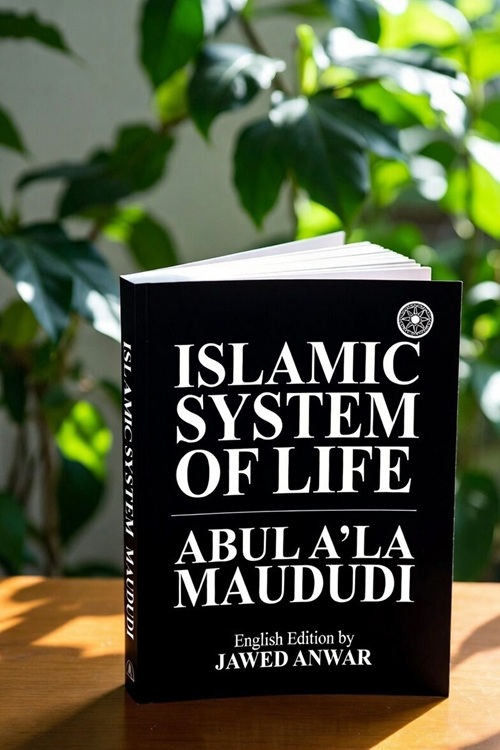
Islamic System of Life - Chapter 5: Islam’s Ethical Perspective
Syed Abul A'la Maududi (1903–1979)
English Edition: Syed Jawed Anwar
[In a world where moral confusion and ethical decay seem to dominate nations, societies, and individuals alike, what is the true foundation for right and wrong? Chapter 5 of Islamic System of Life by Abul A'la Maududi confronts this crisis head-on.]
In ordinary, calm times, when life flows peacefully like a quiet river, people tend to feel a sense of ease. The smooth, clear surface acts as a veil, hiding the mud and filth lying beneath. This outer cleanliness rarely prompts anyone to question what lies hidden below or why it is there.
But when a storm rises in that river—when the hidden dirt and impurities surge up and flow openly across the surface—anyone with even a little sight can see clearly what the river truly carries. In such moments, ordinary people may finally feel the need to trace the source of this pollution and find a way to purify and preserve the river.
If even in these turbulent times people remain indifferent to this need, it shows that humanity has become so intoxicated by heedlessness that it no longer recognizes profit from loss.
The Moral State of Today’s Nations
We are living in exactly such extraordinary times. The river of life is now in full flood. Intense struggles rage between countries and nations—struggles that reach so deep they drag even individuals into the arena of conflict. Most of humanity has now openly displayed the worst moral qualities it had long nurtured inside.
We now see openly on the surface of life the filth that once required effort to detect. Only the truly blind can still claim “the patient is doing well.” Only those completely lacking moral sense—or whose moral sense has been paralyzed—can remain unconcerned about diagnosing and treating this sickness.
We see entire nations, on a massive scale, openly exhibiting the worst moral traits that humanity has always despised: injustice, cruelty, oppression, lying, deception, fraud, treachery, betrayal, shamelessness, self-worship, exploitation by force, and more. These are no longer just individual crimes—they have become national ethics. Great nations collectively commit acts for which their own individuals would be imprisoned.
Every nation has carefully selected its worst criminals to become its leaders and rulers. Under their leadership, no form of villainy remains unpracticed—openly, shamelessly, and on a vast scale.
Nations fabricate lies against one another and broadcast them publicly. Radio waves carry these falsehoods, polluting the very air. Entire countries and continents have turned into bands of robbers and bandits. While robbing others, each proudly accuses its rival of the very crimes staining its own hands.
Justice now means justice only for one’s own people. Rights belong only to oneself. Violating others’ rights is not just permitted—it is considered virtuous.
Almost all nations now apply one standard when taking and another when giving. Whatever standards serve their own interest are upheld; when others’ interests are at stake, those standards vanish. The standards they demand from others, they refuse to follow themselves.
Bad faith has reached such a level that no nation trusts another. Leaders of great powers sign solemn international treaties with refined courtesy, while secretly planning to violate them at the first opportunity. When a president or prime minister sharpens the knife for this sacrifice, no voice of protest rises from the nation—its entire population becomes complicit.
Deceit has become so normalized that lofty moral principles are proclaimed only to fool the world and serve self-interest. Simple people are told: “The sacrifices we demand of you are not for ourselves—we are selfless, noble people enduring all this for the good of humanity.”
Hard-heartedness and cruelty have reached perfection. When one country attacks another, it crushes entire populations with the cold indifference of a steamroller—then proudly announces its deeds to the world, as though it knows humanity has been replaced by wolves.
Selfish brutality has gone so far that one nation enslaves another for its own gain—not only looting it mercilessly, but systematically working to strip it of every noble human quality and cultivate the lowest traits it would despise in itself.
These are just a few of the most glaring moral evils. A full examination would show that the entire body of humanity has morally decayed.
Formerly, brothels and gambling dens were seen as the worst sores of moral decay. Today, human civilization itself appears as one vast ulcer demanding a sharp lancet.
Most tragically, knowledge—the most precious jewel of humanity—is now being used for destruction in every field. The powers and resources God gave humanity are being wasted on corruption and ruin. Even the finest qualities—courage, sacrifice, generosity, patience, perseverance, high resolve—are now pressed into the service of the basest evils.
Clearly, widespread social evils emerge only when individual evils have reached maturity. No society can collectively display immorality while most of its individuals remain upright. It is impossible for good people to place leadership, representation, and authority in the hands of the wicked and allow national, state, and international affairs to be run on immoral principles.
When the world’s nations so openly display these vile moral traits through their collective institutions, it proves that humanity—despite all its scientific and cultural progress—has fallen into severe moral decline, and most individuals are affected by this plague.
If this condition continues unchecked, humanity faces a great catastrophe—a long era of darkness could engulf it. If we do not wish to rush blindly into the pit of destruction, we must trace the source of this storm.
Since this is a moral decay, its origin must lie in the moral concepts prevailing in the world today.
Today’s Moral Concepts
When we investigate current moral concepts, we find they fall into two broad categories:
- Those based on belief in God and the Hereafter.
- Those built on other foundations, independent of these beliefs.
Let us examine both and see their current state and results.
Moral concepts based on belief in God and the afterlife depend entirely on how people understand God and the next life.
Most people who believe in God today are caught in polytheism (shirk). They have—according to their own imagination—divided God’s authority over their lives among many other beings. They have shaped these imagined beings to suit their desires: these beings grant forgiveness for sins, guarantee salvation in exchange for offerings, overlook transgressions, and intercede when God seeks to punish.
They sin freely, then seek pardon through these beings. They go out to steal, confident their patron will keep the police asleep. A bargain has been struck: maintain good faith and offer gifts, and these beings will make everything go smoothly. When God tries to hold them accountable after death, these beings will step in and say: “They are under our protection—let them pass.”
In some places, the punishment is already paid in advance, so no reckoning is needed.
These polytheistic beliefs have emptied the idea of the afterlife of meaning. As a result, all the moral foundations built by religion have become hollow. Religious ethics remain written in books and spoken of respectfully, but polytheism has provided countless escape routes to avoid their application.
Even where belief in God and the Hereafter exists in a purer form, God’s demands have been narrowed to a very small circle of life. A few acts, rituals, and restrictions are seen as God’s requirements for personal and limited social life. Fulfilling these earns a vast Paradise. Beyond that, people feel free to run their lives however they wish.
If they fall short even in these limited demands, they trust God’s mercy and leniency to forgive their mountain of sins and grant them entry to Paradise with an honorary ticket.
This narrow religious conception has severely limited the application of religious ethics to life’s affairs. Most major areas of life have become free from any moral guidance or restraint that religion could provide.
Even within this narrow circle, escape routes remain open, and few hesitate to use them.
The best condition exists among those religious groups that are free from polytheism, sincerely believe in God, and do not rely on false hopes about the afterlife. Among them, moral purity and excellent character can certainly be found. Yet the limited conception of religion and spirituality has harmed even them.
They have largely detached themselves from the world and its problems. They either focus on a few specific acts considered “religious,” or they polish their souls to hear voices from the unseen and glimpse reflections of Absolute Beauty in this world.
For them, salvation lies in skirting the edges of worldly life. Closeness to God comes from shaping outward aspects of life according to a religious blueprint, purifying the self through certain methods, and spending life in a limited range of religious and spiritual pursuits.
It is as though God needed a few beautifully shaped glass vessels, some finely tuned loudspeakers, excellent gramophones, delicate radios, and attractive cameras—and sent humans to earth with so much provision only to transform themselves into these things and return to Him.
The greatest harm of this distorted religious view is that the noblest souls—those with the highest moral capacity—have been pulled away from the field of life into corners. This has left the arena open, without resistance, for those with the lowest qualities.
This is the overall religious situation in the world today. From it, you can see that the moral power religion could give humanity has mostly not been received. A small number do receive it, but they have voluntarily withdrawn from guiding and leading humanity.
The result is like a battery fully charged but left unused—its life simply runs out.
The people actually running the world’s affairs today have deliberately emptied their ethics of belief in God and the Hereafter. Though many claim some religion, they view it as a purely personal matter to be kept private. Religion has no connection to collective life and its affairs. Why, then, should they turn to superhuman guidance to run them?
In the late 19th century, a moral movement began in America and spread to England and elsewhere. The American Ethical Union stated its purpose as: “To emphasize the supreme importance of morality in all human relations—personal, social, national, and international—without reference to religious creeds or metaphysical beliefs.”
In England, the Union of Ethical Societies (later the Ethical Union) declared: “To promote a way of human fellowship and service based on the principle that the highest good is love of goodness, and that moral ideas and moral life require no creed concerning the nature of the universe or life after death; and to train people, by purely human and natural means, to love, know, and do the right in all their relations.”
These words represent the mindset now guiding much of the world’s thought, civilization, culture, and affairs. Those running the world today largely share this view: ethics must be independent of God and the afterlife. Even if they believe in God, they believe only in His existence—not in taking principles or rules from Him for life.
A Review of Non-Religious Ethical Philosophies
Now let us examine these non-religious ethical philosophies and see their true nature.
- The first fundamental question in ethical philosophy is: What is the ultimate good that human effort should aim for? By what standard do we judge actions as good or bad, right or wrong?
Humanity has found no single answer. There are many:
- For some, it is happiness.
- For others, perfection.
- For still others, duty for duty’s sake.
Even among happiness advocates, questions arise: What kind of happiness? Physical and sensual? Mental and intellectual? Artistic or spiritual? Whose happiness? The individual’s? The group’s? All humanity’s? Others’?
Similar questions arise for perfection advocates: What is perfection? Whose perfection?
Those who uphold duty for duty’s sake face the question: What is the absolute, unconditional law (categorical imperative)? Who made it? Why is it binding?
These differing answers are not just in philosophical books—they exist in practice. The vast crowd running human civilization—ministers, generals, judges, legislators, teachers, businesspeople, workers—each holds a different standard of good and evil.
One person’s ultimate good is personal pleasure—physical and sensual. Another pursues a different pleasure. Each judges actions as good or bad based on what advances their own happiness. Yet their polished appearance often deceives us into thinking they are fit to lead or judge.
Similarly, those who see good in the happiness of their group, community, or nation treat outsiders as enemies—while we mistakenly see them as upright.
The same diversity—and danger—exists among perfectionists and duty advocates. Many of their views, in practice, are poison to human civilization—yet they are absorbed into society under the label of cure.
- The second basic question is: What is the source for knowing good and evil? Where do we turn to learn what is right and wrong?
Again, no single answer exists:
- Some say humanity’s experience.
- Others say knowledge of the laws of life and existence.
- Some say intuition.
- Others say reason.
Here the disorder reaches its peak. Without a fixed standard, ethics becomes fluid—shifting and adapting to every mind, group, and era.
To gain true knowledge from human experience requires complete, detailed information and a perfectly balanced mind to draw conclusions. Neither exists. Human experience is ongoing. What we have is fragmented, and different minds draw different conclusions based on their biases.
If experience cannot provide certainty, how can incomplete knowledge of life’s laws and conditions do so? Reason and intuition suffer the same limits.
No one can claim any of these is sufficient by itself to establish ethics. When any one is taken as the final authority, ethics loses stability—good becomes evil, evil becomes good, depending on time, place, and perspective.
- The third question is: What power enforces the moral law? What motivates people to follow it despite natural inclinations?
Answers vary:
- Some say pleasure’s promise and pain’s threat are enough.
- Others say the desire for perfection and aversion to deficiency suffice.
- Some trust the inner respect for law.
- Others rely on the state’s rewards and punishments.
- Still others point to society’s approval or disapproval.
Each of these has influenced real moral systems—and each has proven equally effective at motivating evil as good. In fact, they often motivate evil more powerfully. None can sustain high moral character.
- The same problem arises when asking what motivates people to follow moral rules against natural urges.
These answers have produced chaos in practice. The first two led to individual lawlessness so extreme that social order nearly collapsed. The backlash created philosophies that either made the state into a god (enslaving individuals) or handed individuals’ moral reins to society.
None is holy or infallible.
The Correct Foundations of Human Ethics
My research leads to one conclusion: The only sound foundation for ethics is the one Islam provides. Here, all the basic questions of ethics find answers free from the weaknesses of philosophical systems.
Here, too, are absent the flaws of narrow religious ethics that cannot build strong character or equip people to handle the broad responsibilities of civilization.
Islam offers comprehensive moral guidance that can advance every area of life to its highest possible level. It provides ethical principles on which a truly righteous civilization can be built—protecting humanity from the chaos it now faces.
Here is how I reached this conclusion:
Philosophy begins its ethical discussion at a secondary point, skipping the real starting point—and this is its first mistake. The question “By what standard do we judge actions as right or wrong?” comes after a more fundamental one: What is humanity’s true position in this world?
This question is decisive. Without determining our position, ethics becomes meaningless—or worse, fundamentally wrong.
For example: To decide how you should act toward a property and what rights you have, you must first know your relationship to it. If it belongs to someone else and you are its trustee, your ethics differ completely from if you are its absolute owner with unlimited rights.
Ethics depends on position.
Islam begins here and declares with complete clarity: In this world, humanity’s position is that of God’s servant and vicegerent (khalifah). Everything we encounter belongs to God—even our bodies and powers. God has appointed us as trustees, giving us authority to use these things—but we are being tested in how we use them.
The final outcome of this test will not appear in this world. When all individuals, nations, and humanity’s work is complete—when the effects of our actions reach maturity—God will judge us all at once, deciding who fulfilled the trust of servitude and vicegerency and who did not.
This test covers everything God has given us—not one thing, but all things. Not one role, but all roles. Not one area of life, but the whole of life.
Our reason, sources of knowledge, mental and intellectual powers, senses, emotions, desires, physical abilities—all are being tested. In the outer world, every interaction with things and people is a test. Above all, the test is whether we act with the awareness of God’s lordship and our servitude and vicegerency—or whether we act with arrogance, independence, or servitude to others.
Logically, this position means we have no right to determine our own ethics. That right belongs to God—the One testing us.
Once we accept humanity’s position as God’s servant and vicegerent, the answers to philosophy’s questions become clear—and free from the flaws philosophers introduce.
If we accept this position, the highest good becomes succeeding in God’s test and earning His pleasure. An action is right or wrong based on whether it helps or hinders reaching that good.
This also determines the true source of moral knowledge: God’s guidance. Other sources (experience, reason, intuition) can support it but cannot replace it.
Further, the binding power of the moral law comes from its being God’s law. The true motives for good conduct are love of God, desire for His pleasure, and fear of His displeasure.
Islam thus eliminates the chaos of trying to build ethics without God. It provides a complete moral framework without the weaknesses of either narrow religion or godless philosophy.
The Impact of Islam’s Ethical View on Human Life
This conception of God—that He alone is the Creator, Sustainer, Lord, and absolute Ruler of humanity and the universe—produces a complete moral life free from the flaws of both polytheistic religions and materialistic philosophies.
Here, no escape routes exist from moral responsibility. No room remains for unjust philosophies that divide humanity and favor one group over another based on self-interest.
Nor do the basic weaknesses of godless ethics appear here.
This view sets the highest and broadest goal for moral excellence—one with no limit—and provides the purest motives to pursue it.
It also determines both the path and the purpose of human life. As God’s vicegerents, our sole aim must be to fulfill God’s will on earth: establishing His law, creating peace and justice according to His pleasure, suppressing corruption, and promoting every good He loves.
This purpose not only rejects the false goals of pleasure-seekers, materialists, and nationalists—it also rejects the misguided goals set by distorted spiritual views.
Between these two extremes, the concept of vicegerency places before humanity the highest and purest purpose—one that engages all our powers and abilities across every field of life, directing them toward building the most righteous civilization.
These are the foundations Islam provides for rebuilding human ethics. Islam is not the property of one nation—it is the common heritage of all humanity, aiming at the well-being of all.
Anyone who desires their own and humanity’s welfare should consider: Are these foundations—provided by Islam—better for building human ethics than those offered by philosophical systems or narrow religious views?
If your heart bears witness that these are the correct foundations, no ignorant prejudice should prevent you from accepting them.
LEAVE A REPLY
Recent posts
-
Islamic System of Life - Chapter 9: Bearing Witness to the Truth
09 February 2026 -
Islamic System of Life - Chapter 8: Jihad in the Path of God
08 February 2026 -
Islamic System of Life - Chapter 7: Construction and Destruction
08 February 2026 -
Islamic System of Life - Chapter 6: The Moral Foundations of the Islamic Movement
08 February 2026 -
Islamic System of Life - Chapter 4: The True Deen (Way of Life)
26 January 2026 -
Islamic System of Life - Chapter 3: Islam and Jahiliyyah (Ignorance)
25 January 2026
Comments
Samuil
Very Interesting